Q&A
Downtown Lafayette, Louisiana is entering a pivotal chapter of reinvestment, and the Downtown Development Authority is leading that momentum with a clear vision for public realm improvements, stormwater innovation, and community driven design. We sat down with Rachel Holland, Director of Planning and Design for the Downtown Development Authority, to discuss the work underway on Lee Avenue and the broader effort to strengthen downtown’s livability and economic vitality. In this conversation, she shares how the partnership with Design Workshop has shaped the city’s approach to stormwater, third space amenities, and long term corridor planning. Her insights highlight what it takes for a mid-sized city to balance growth with placekeeping and how thoughtful design can help Lafayette close the reinvestment gap while honoring its cultural roots.
Tell us more about your role at the Downtown Development Authority in Lafayette.
Downtown Lafayette is served by two organizations working in tandem, the Downtown Development Authority, which is a public entity, and Downtown Lafayette Unlimited, a member-based nonprofit. Together, we're focused on making downtown more livable by coordinating public investment, promoting private development, and programming public spaces for a wide range of audiences. My role sits at the intersection of all of that. I lead our long-range planning, drive policy initiatives, and coordinate public realm improvements, but I also spend a lot of time as a liaison between the public sector and the private development community, trying to understand what's getting in the way of investment and advocating for the improvements that make those folks successful. We’re behind where a lot of comparable cities are in terms of downtown reinvestment, and closing that gap drives everything we do.
From your perspective, what made Design Workshop the right partner for the Downtown Development Authority as you began shaping the vision for downtown Lafayette?
Claire Hempel with Design Workshop wasn’t a stranger to Lafayette. In fact, about a decade ago, she led a major public engagement process over many years for Moncus Park, a 100-acre green space in the middle of our city. Her history in Lafayette meant a lot to us, and I think our downtown community was craving a creative engagement process.
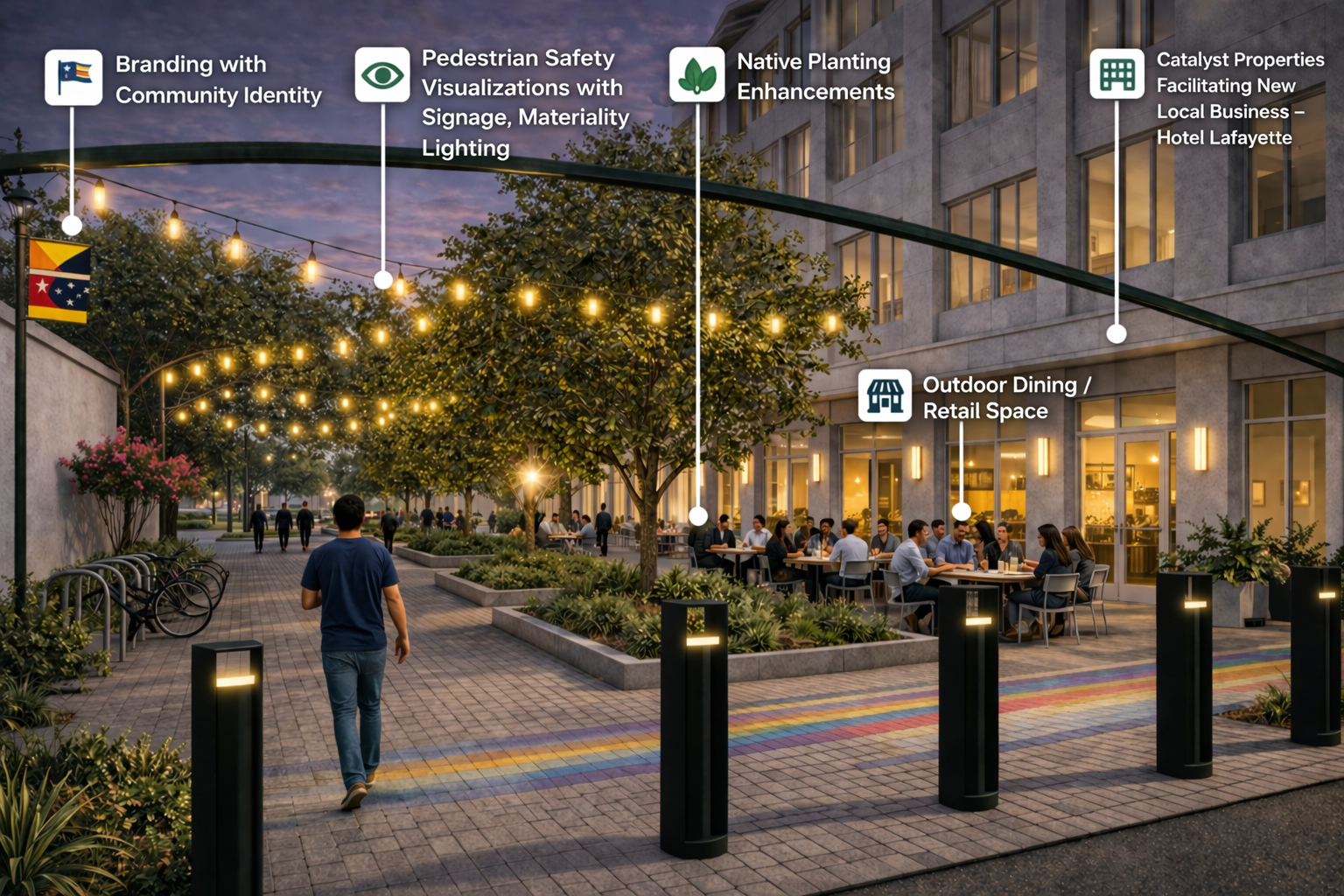
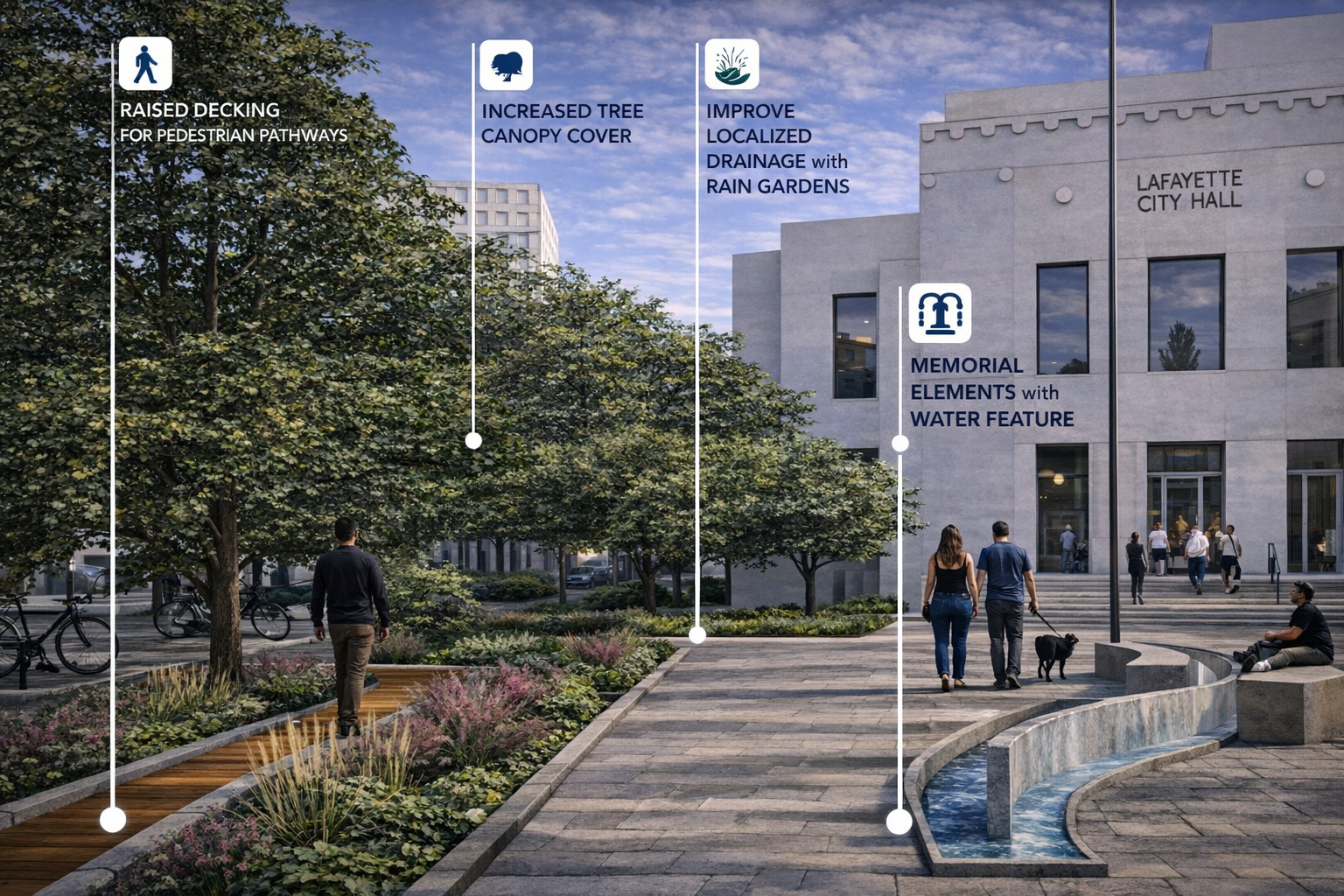
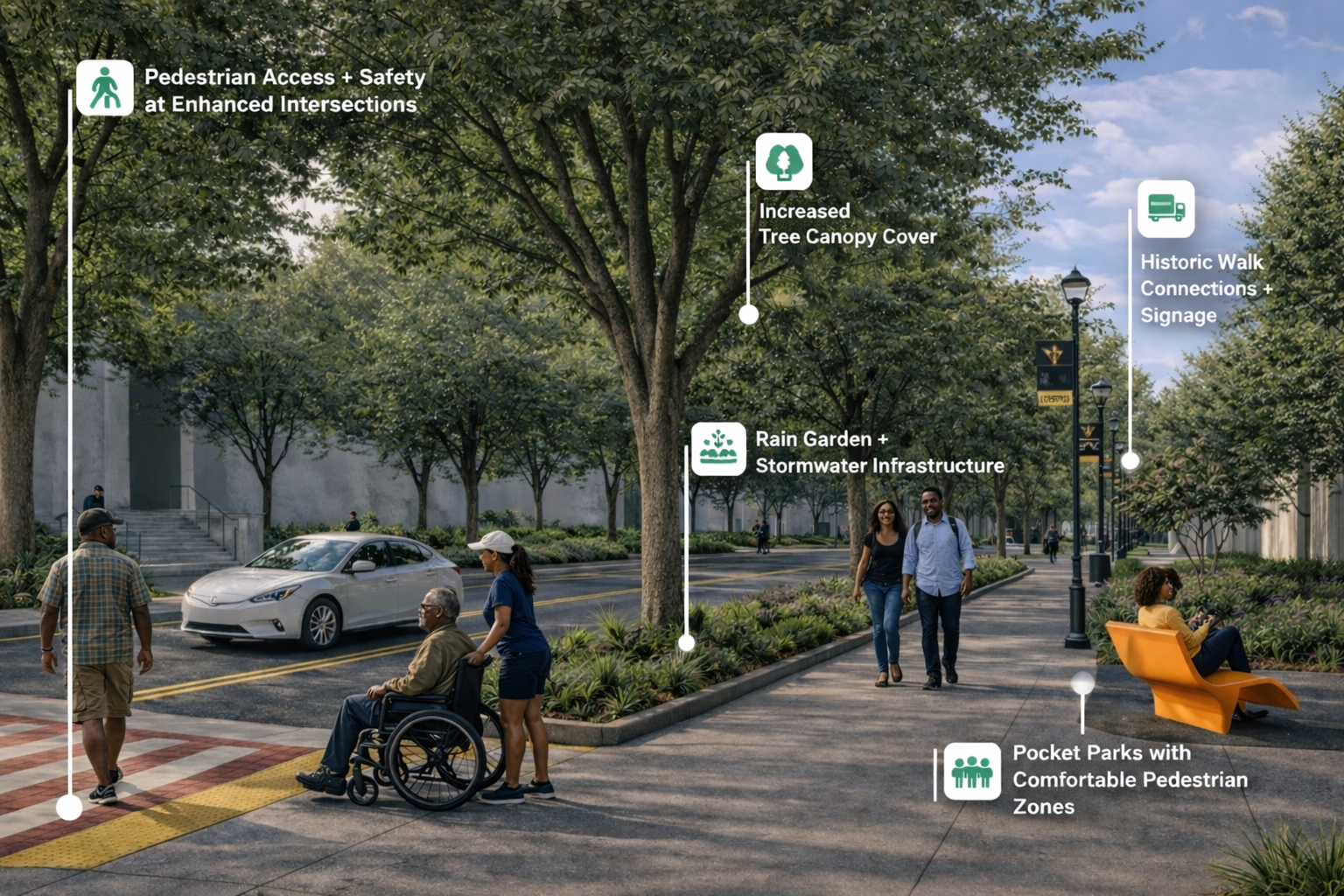
Beyond that, Design Workshop’s work on Bagby Street in Houston showed us they understood how to do more than just move people along a corridor. We wanted to fundamentally rethink our relationship with stormwater on Lee Avenue while also creating more moments of respite throughout downtown, third spaces that aren't tied to a business, where people can just be. The Design Workshop team got that instinctively. Lee Avenue is actually the main drainage line for much of downtown and an adjacent neighborhood, so stormwater is a real infrastructure problem on the corridor. Their approach seeks to let us store more water, improve water quality downstream, and slow flows before they hit a bottleneck as the water exits downtown, all while bringing visible rain gardens back to the street. We also saw this as an opportunity to set an example for the rest of Lafayette, to figure out how to pull off thoughtful stormwater management in a dense, constrained urban environment; those same solutions become a lot easier to replicate where there's more space to work with.
How has Design Workshop's approach, particularly their emphasis on community engagement and performance-based design, influenced the direction or outcomes of your downtown initiatives?
It was really refreshing to bring landscape architects in on the front end of a streetscape project, that's not always how these things go, and I think it made a difference for our stakeholders. The conceptual plan they delivered carefully considers each block, how each business or future development interacts with the public realm, and weaves third-space amenities throughout the corridor, going well beyond what we originally scoped. And then, right in the middle of our contract, we announced downtown's first full-service hotel along that same corridor and the Design Workshop team pivoted to help us facilitate conversations between the public and private sectors to ensure the hotel would give back to the street and the park it’s next to. What I'm also really proud of is that this process helped us build a coalition that engaged stakeholders and civic leaders. People who now understand what good planning looks like and expect it. That's going to matter for every corridor project we take on next.
Can you share a moment or milestone in the project where you felt the collaboration with Design Workshop made a meaningful difference for the community?
One of our future park spaces is located on the site where a Confederate monument stood before our city took it down in 2021. It’s a space that carries a lot of weight for many people in our community, and we knew going in that we had a responsibility to handle it carefully. Design Workshop helped us navigate some genuinely difficult conversations about race and history with a lot of grace, and they helped our office find the right role in a dialogue that was deeply personal for many residents. We brought in voices from all corners of the community, and we’re prepared to present a concept that the community actually authored. There's still a lot of work ahead, but we have a framework to build from, and we're now in a much stronger position to pursue funding and grants to make it real.
Downtowns often face complex challenges that require balancing economic vitality, mobility, culture, and public space. How has Design Workshop helped you navigate those complexities?
The reality is we're a mid-sized city with limited resources, and when we commit to a major capital project, we need to get it right and we can't afford to close the door on smarter solutions down the road. Design Workshop understood this; they were quick to recognize when the work called for expertise beyond their own, and they knew the right people to bring into the project. They also came in with genuine respect for the planning work that had been done before them and built off of it, rather than starting from scratch.
But what really stood out to me was how embedded they became in what was happening locally. They stayed on top of news in Lafayette, flagged things that might affect our project, and brought in lessons from other communities they'd worked in. Claire and her team saw themselves as an extension of our office, and they had a good sense of how to keep people with differing opinions at the table and moving in the same direction.